|
What
is Ethernet?
 Ethernet is a type of network cabling and signaling specifications developed by
Xerox in the late 1970. While Internet is a global network, Ethernet is a
local area network (LAN). No computer should be an island. With Ethernet, file
sharing and printer sharing among machines became possible. The term "ether" was coined by Greek philosopher Aristotle to describe the "divine element" in the heaven. In the 17th century, French philosopher and mathematician Rene
Descartes theorized that the universe has no void; all space, including the heaven and the earth, is filled with ether, which is composed of very fine particles. In short, "ether" is said to be a kind of substance that exists everywhere. Although this is a misconception, network developers still adopted the term "ether" and therefore "Ethernet" means "a network of everywhere." Ethernet is a type of network cabling and signaling specifications developed by
Xerox in the late 1970. While Internet is a global network, Ethernet is a
local area network (LAN). No computer should be an island. With Ethernet, file
sharing and printer sharing among machines became possible. The term "ether" was coined by Greek philosopher Aristotle to describe the "divine element" in the heaven. In the 17th century, French philosopher and mathematician Rene
Descartes theorized that the universe has no void; all space, including the heaven and the earth, is filled with ether, which is composed of very fine particles. In short, "ether" is said to be a kind of substance that exists everywhere. Although this is a misconception, network developers still adopted the term "ether" and therefore "Ethernet" means "a network of everywhere."
How does it work?
Ethernet uses a communication concept called datagrams to get messages across
the network. The Ethernet datagrams take the form of self-contained packets of
information. These packages have fields containing information about the data,
their origin, their destination and the type of data. The data field in each
package can contain up to 1500 bytes. Take mailing as a metaphor. An Ethernet
package is not just a letter. It is also provided with the sender address, the
receiver address, the stamp indicating what the package's contents are.
What are the number, and the words
"Base" and "T"?
There are several standards of Ethernet, such as 1000BaseT, 10GBaseT...etc. The
number stands for signaling speed: "1000" is 1000 mega bit per second.
However, it is important to point out that this number indicates the
"ideal" situation. The actual speed might be slower. "Base" means
Baseband, which uses a single carrier frequency so that all devices
connected to the network can hear all transmissions. "T" stands for
twisted pair cable.
Half-duplex vs. full-duplex
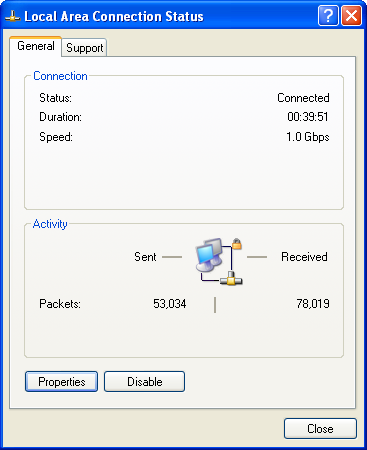
Ethernet suffers from collision when it is running in half-duplex mode. What is half-duplex? CB radio is a typical example of half-duplex. When using a CB radio, you can either send a message or receive a message at one time. When two or more computers attempt to send data at the same time, a
collision occurs. Nevertheless, switches make it possible to run Ethernet in full-duplex mode. In this mode, two computers
establish a point-to-point connection in full-duplex and thus collisions are avoided.
Advantages of Ethernet
Upgradability: There are several other superfast
network protocols. Some of them must use Fiber optics and thus its price is much
greater than that of Ethernet. But some superfast networks, such as 100G BaseT Ethernet, are based upon
more affordable technologies. Therefore, installing BaseT Ethernet may make the upgrade to a faster network easier in the future.
Simplicity of installation: In the past IBM Token Ring
was a rival of Ethernet, but like IBM's OS/2 lost the OS war to Microsoft
Windows, Token Ring also lost the network war. Although it was capable of transmitting signals
at 16 million bit per second, which was faster than 10BaseT Ethernet (10 megabit
per second), it was very difficult to configure. Networking expert Frank Derfler said, "The Token Ring is to networks what the Boeing 747 is to airplanes. It makes strange noises and requires special handling."
Installation of Ethernet is easier and less expensive than other network
protocols. It offers efficient ways to connect across Mac, PC, Linux, Unix
workstations, IBM mainframe, and many other kinds of computer systems.
Therefore, Ethernet is more popular than other network protocols.
Connectivity to backbone: As mentioned before,
Ethernet is a local area network protocol for different sub-networks of a
company or a campus. For networking the entire company or campus, it needs a
backbone network protocol. A backbone network is like a fish's backbone, to
where every smaller bone (sub-network) is connected. Ethernet has an advantage
in connectivity to backbone because other LAN protocols lag behind in backbone
innovations. For instance, the only way to upgrade Token Ring backbone was to move to
Asynchronous Transfer Mode (ATM). In contrast, Ethernet have several choices such as Gigabit
Ethernet, ATM, and routing switches.
Navigation
|